
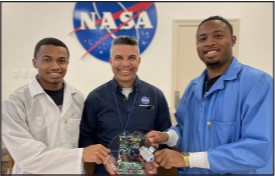
The Artemis program is said by NASA deputy administrator Pam Melroy to be the “one of the most important scientific endeavors of the generation” and Langston University is a part of it. The Artemis program is a space exploration program that is set to get Americans back on the moon for the first time since 1972.
“What we are doing here at Langston is supporting the Artemis Mission by educating our students in the rocketry and the ROCKON Project,” says Mr. White the primary mentor for the project. Mr. White works with Grant Consortium Director Dr. Howard-Smith along with Dr. Davis, Dr. Reid, and Dr. Fondjo to be mentors and support the students participating in the ROCKON Project. In which Langston University students build a real-sounding rocket payload and launch it on a two-stage Terrier-Orion rocket into outer space. A sounding rocket payload is a rocket payload that contains data collection devices or a science experiment to be done once in space. A two stage Terrier-Orion rocket is a rocket designed to use the Terrier booster rocket to launch from Earth but once the Terrier rocket runs out of fuel the rocket will separate exposing the Orion rocket engine which will start up allowing the rocket to fly even higher without the extra weight from the Terrier engine and fuel tank.
The 2023 ROCKON Langston team consisted of five members each having a title and a field of focus. Trendon Edwards junior major in Chemistry as the project manager and chemist, Nyla Banks junior major in Agronomy/ Agribusiness as assistant project manager scientist, Kaleb Barnes graduated major in Computer-aided Design/ Technology as design engineer, Charles Lett Jr. graduated major Computer Science as computer scientist, Reginald M. Archibald II junior major Computer Science as computer scientist. The ROCKON project was split into five objectives to actively engage the students through the full process from the design phase all the way to launch.
The first objective, primarily handled by the project manager and assistant project manager, was scheduling of the rocket launches using model rockets on Langston University’s campus, maintain inventory of the workshop, and create acquisition and requisition reports for the materials needed.
The second objective, which was handled primarily by the chemist and assistant project manager, was understanding the chemical makeup of the rocket materials and their molar masses. The molar mass is the ratio between the mass and the amount of a substance. They also needed to analyze data collected by using properties of atmosphere and matter to determine temperature, pressure, speed, and acceleration.
The third objective, handled primarily by the design engineer, was to understand rocket history, center of pressure, center of gravity, design and build the model rockets that were to be launched on Langston University’s campus. This includes the rocket motors, payload, and recovery system before they were to coordinate the launch.
The fourth objective, handled mainly by the computer scientists, was using an Arduino minicomputer to create a hardware and software system to collect data and then store the data on an SD card for analysis. The sensors, Arduino minicomputer, and SD card are the payload for the rocket. Archibald said, “I mainly worked on the software portion of it, not the hardware. That was my job, to make sure all the codes match up properly… because there was a different code for each sensor.” He was also responsible for testing the sensors, checking his codes, making sure the proper wires were connected, and analyzing the data received after testing to make sure the project was headed in the right direction.
The fifth objective was to document the progression of the project by the way of photos, video, oral presentation, and written work.
Upon construction of the model rockets, which were launched on Langston University’s campus, all six model rockets launched successfully. The model rockets that were launched ranged between 18 inches and 36 inches and were able to get data on how the rocket was interacting with the atmosphere. The launch simulated a real mission that Langston students would get to be a part of during the 2023 ROCKON workshop at the Wallop Flight Facility in Virginia. Langston students spent a week building a payload in a workshop with 28 other teams from colleges and universities from all over the country. These students were able to participate in workshops to learn essential skills and had the responsibility of briefing all the PhDs that were on the team every morning. Once the students had completed construction of their payload, they then integrated it into a canister, which is a kind of protective housing for the components of the payload, making it easier to attach to the rocket. Upon completion, the students went out to the test facility where the payload was chill tested, electrical tested, and then vibration tested to ensure that the canister and payload could withstand the rigors of a rocket launch. After the completion of the project the payload was integrated onto the rocket. Due to the launch eventually being postponed, the students did not get to see the rocket launch but instead went to the Virgina Air and Space Musuem. “We had bad weather out there, so it got postponed… the first time, that’s why we’re getting our data later. The sea levels were too high, meaning when the rocket comes back down and lands in the Atlantic Ocean… the waves and the sea state were not safe enough for them to recover it,” Archibald explained. The launch was then set for Aug. 16; however, the mission was again postponed by Nasa mission controllers following an anomaly with the second stage rocket. The rocket then successfully launched on Aug. 17. Once its mission was completed, the payload splashed down in the Atlantic Ocean where it was recovered, and Langston University’s payload was returned to the university where the ROCKON team had begun downloading and analyzing the data.

The Artemis program is a space exploration program that is a collaboration of government space agencies and private spaceflight companies bound together by the Artemis accords and led by the United States. The Artemis program is to be split into five space launch system (SLS) missions, each one increasing in complexity and taking place within a year of each other with the final confirmed mission Artemis 5 having a launch scheduled for 2029.
Artemis 1 launched in November of 2022 and was an uncrewed first test flight of both the SLS and Orion spacecraft. The unmanned spacecraft flew to the moon and entered a polar orbit where it stayed for 6 days before returning to Earth and successfully splashing down in the ocean.
Artemis 2 has a planned launch for 2024 and will be the first manned test flight of the SLS and Orion spacecraft. The Artemis 2 crew will perform extensive testing upon entering orbit around Earth, before flying to the Moon on an elongated free return trajectory, meaning that the crew of the Artemis 2 will go farther away from Earth than any human has ever been before returning to Earth.
Artemis 3, which has a planned launch date of 2025, is set to be the first manned moon landing since 1972. The Artemis 3 is also planned to have the first person of color and woman on the moon. Artemis 3 will head into an orbit of the moon where it will rendezvous with the beginnings of a lunar space station to be known as the Lunar Gateway and the starship human landing system (HLS), all of which were sent up by supporting space agencies and spaceflight companies. Upon docking with the HLS, two of the four crew from the Orion will transfer to the HLS and proceed down to the lunar surface where they will spend six days. Then the HLS will launch from the lunar surface, and dock with the Orion spacecraft which has been in orbit. The four crew members will then return to Earth in the Orion spacecraft.
Artemis 4 with a launch date set for 2028 will also be a manned lunar landing. Artemis 4 will rendezvous and dock with the lunar gateway space station where it will deliver the I-HAB gateway module. This will only be the second module added, the first one being added by another agency. The crew of Artemis 4 will then take an upgraded HLS craft to the lunar surface where they will spend a to be determined amount of days before returning to Earth.
Artemis 5 having a launch slated for 2029 is also the third lunar landing mission; however, the Artemis 5 will also have a large cargo delivery to make upon reaching the Lunar Gateway Space Station. It is planned to deliver the European space agency’s ESPIRT refueling and communications module to increase the size of the space station. Along with a Canadarm2, which is a 17-meter-long robotic arm which is to be used extensively during assembly of the orbiting laboratory.
The last thing the mission will be delivering is NASA’s lunar rover. Artemis 5 will also be the first mission to use the Blue Moon Lander when bringing astronauts down to the surface of the Moon. After completion of the Artemis 5 mission the participants of the Artemis accords will be in a prime position to establish a lunar base and further exploration towards Mars.

Tristan Dozier
Staff Writer
Tristan Dozier is a senior corrections major.
Story ideas, opinion editorials, calendar events and advertising requests can be sent to dthom34@langston.edu. You may follow The Gazette on Instagram @lu_gazette.
The Gazette serves as the student voice of Langston University. It is produced within the Department of Communication as a teaching tool and local news source for the campus community. The views and opinions expressed within are those of the writers whose names appear with the articles and do not necessarily represent the views of Langston University.


