
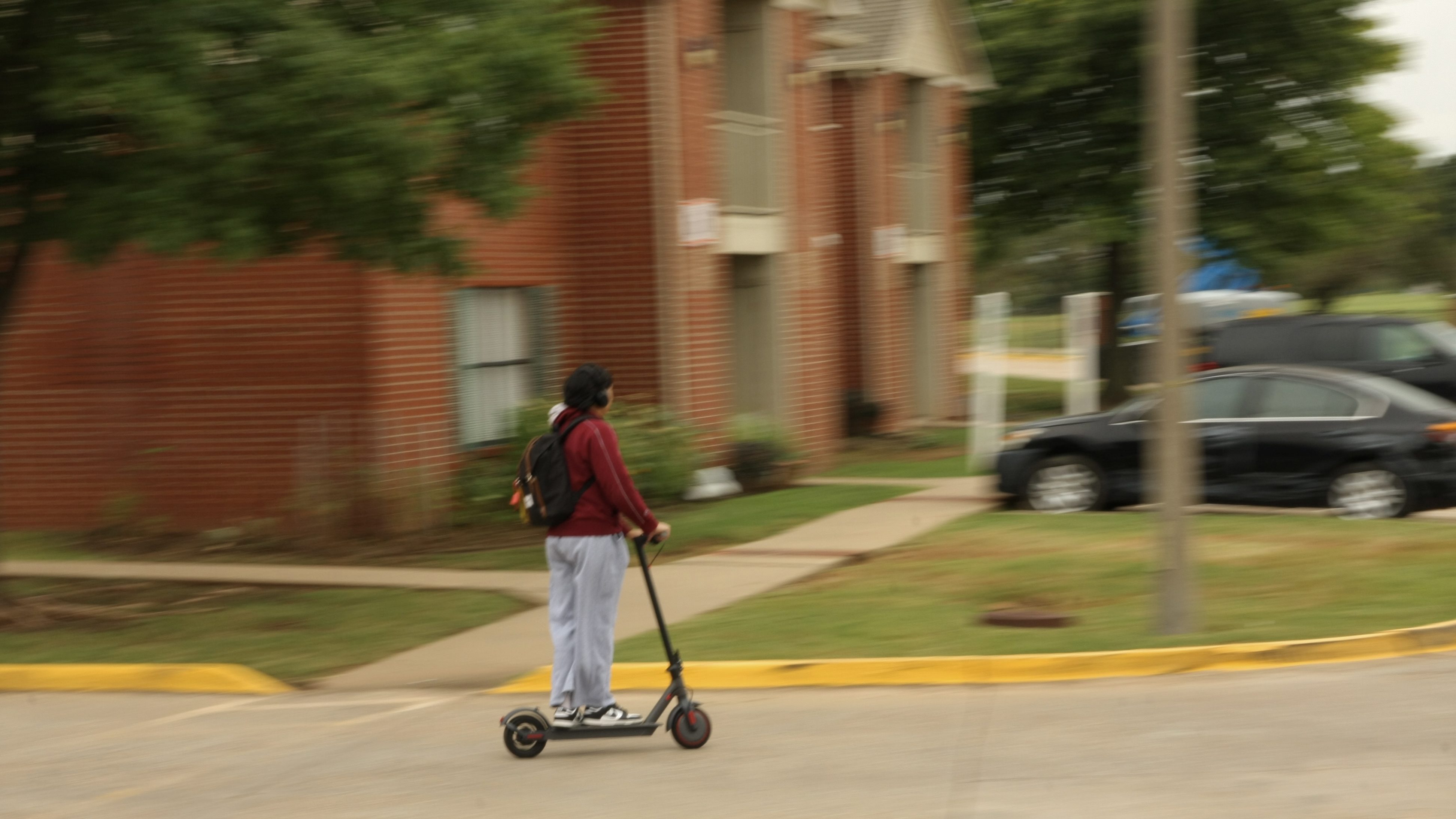
As the sun begins to set, Joel Gibbs is leaving the Commons housing community and heading to his dorm in Scholars Inn. He can see where he’s going, but he has a hard time scanning for potholes as he glides towards the rear entrance of the university.
He spots a large pothole just in time to go around it, but in doing so he launches off another pothole and bursts his tire. Luckily, he only got minor scratches and cuts. His bike has been out of commission since.
Although Langston is a smaller campus, getting around is still a challenge students grapple with constantly, especially when living in the distant housing communities like Commons and Scholars Inn. Most students opt to walk to class, but some use other methods to cut the ten to fifteen minute walk down to five or less.

Gibbs, a sophomore music education major, has gone to his classes using his bike and a skateboard. He already had his skateboard before going to college so it was natural for him to ride it to get to classes.
One downside is that the board is unusable in the rain due to the risk of slipping. The wood will get soaked through, and the wheels can rust. Gibbs also warns that “a lot of the red dirt turns to sludge, so you step into that, it’s going to be stuck on.”
To Gibbs, skateboarding is less dangerous than one would think. He even says he’s more likely to fall when biking at night, when potholes are harder to see and avoid on a bike than on his skateboard. The ease of getting off his board when he spots a rough patch makes skateboarding his go-to at night.
He says that “even if you do fall while you’re skating, the fall isn’t gonna be as catastrophic.” The speed of bikes make their crashes a lot more dangerous than skateboarding. He says when falling on a skateboard, “you could easily step off or just tuck and roll.”
His only fall on the skateboard came in his first semester here at Langston. He was less aware of potholes at the time and hit a pothole without realizing how big it was.
He was left mostly unhurt, but he completely destroyed his phone. He claims he, “learned his lesson”, about potholes right there.
Joel finds biking to be faster than skateboarding, since you can ride uphill and downhill somewhat equally. It is slightly less durable since the tires can be damaged easily. He is also considering installing a rear rack, which can help make pedaling easier.
To Joel, the biggest thing to know when riding around Langston is that there are a huge amount of dangerous potholes to be aware of. Since his crashes, he has decided it would be better to walk in areas with uneven ground.
Van Dyke Atienza, a sophomore computer-science major, uses and electric scooter to get to class. He finds that, “walking is time consuming when as a college student, time is very important”.


His scooter can get to class faster than a bike, without any physical strain. He says it’s “more convenient when I’m tired from band practice”.
A small drawback to his scooter is that he must charge its battery once every few days. Another drawback is that it is even heavier than most bikes at around 40 pounds.
Van says, “I live on the second floor, so I got to carry it every time I go back, but it’s not that much of a problem for me.”
Like the skateboard and bike, Van’s scooter is easy to crash when driving over potholes or uneven ground. Van only crashed once, while taking a hand off the handles to wave at a friend. He got a big gash on his knee, but was not hurt other than that.
Although the scooter is electric, it is waterproof and has no issues riding in the rain. Van says it allows him to go places he might not consider going to because of the length of the walk.
All vehicles speed up the time it takes to get to classes, and add some fun to the trip there. They each have their situations and advantages for different people, and it may be worth it to consider trying out a new way of getting to class, if you have some wheels available to you.

Jeremy Arballo
Jeremy Arballo is a sophomore broadcast journalism major


