
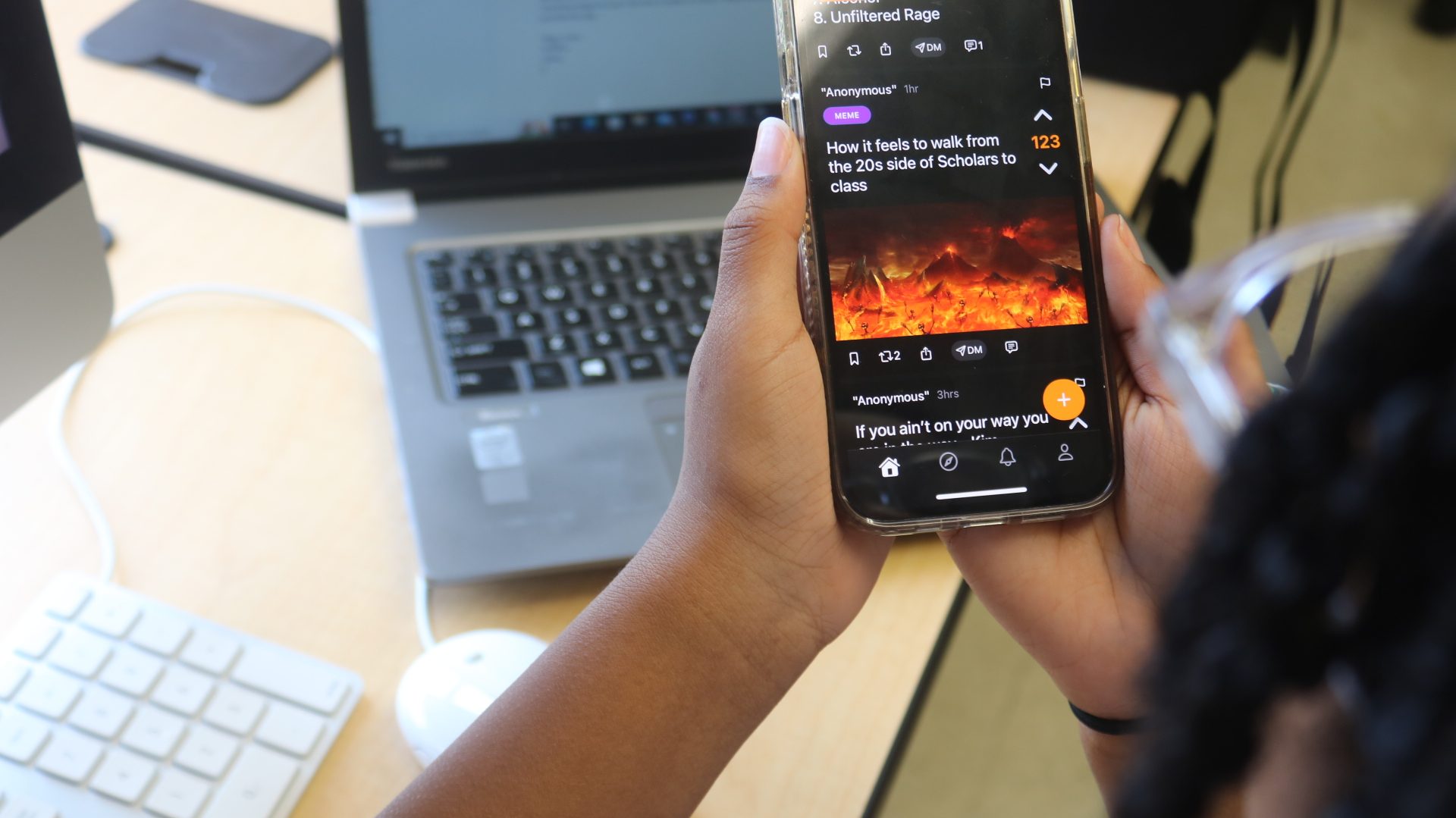
Fizz, as many students may know, is an anonymous social forum app for college students across campuses to connect with one another. The app’s origins are based in Stanford, California, where two Stanford students created the platform “to be an uplifting digital space for Gen-Z and a go-to destination to stay updated.”
When Langston students were asked about their feelings regarding the platform, their answers aligned with the app’s overall purpose.
One user said, “Fizz is great for spreading awareness for things that are happening on campus! I like to use it to figure out things that I don’t know that upperclassmen usually do.”
Another user agreed, “Most of the time it’s the best way to find answers or … new things about the schools.”
In addition to these responses, staff writer Anthony Henry conducted a poll asking students how they felt about Fizz, and 40 out of 70 students said the app brought them closer together.
Although the app’s positivity is real, the forum has garnered quite a notorious reputation in the almost three years it has been accessible for Langston students, with many students disagreeing with this positive outlook. In a previous Gazette article titled “Fizz App: How Anonymous is Anonymous?”, these contradictions are brought to the forefront.
These students feel that the app is a breeding ground for messiness that harms LU’s campus culture by allowing people to say whatever they want under the power of anonymity.
Given its notoriety, why are students (and even staff) so invested in it?
Chair of Langston’s psychology department and acting dean of the School of Education and Behavioral Sciences, Dr. Elizabeth Albright, shared some insight.
“So a lot of it has to do with that dopamine hit, and so you kind of get that little rush of adrenaline, and a little excitement there … the bad thing about that is that when you feel that, you want to experience that again. Like, subconsciously, your brain wants to experience that again, and so the tendency is, if you can get away with it one time, you’ll get away with it multiple times. So it kind of builds into a sort of … addiction. I mean, I hesitate to go all the way to that point, but it kind of becomes something that, you know, you feel really comfortable with, and you feel almost compelled to do.”
COVID-19 also caused a major shift that influenced students’ tendency to connect digitally.
“What’s bad about it is it does lack that human interaction and then it can become more difficult to actually interact in person, and that’s a really important skill. One of the things that I and some of the other instructors have noticed, particularly with the incoming freshmen, perhaps the sophomores here … is kind of a little bit of a lack of social skills. … it’s not your fault or anything like that … that early high school time was online. There is a human disconnect.”
According to Albright, COVID’s impact was especially strong during the middle and high school periods, which psychology has found to be important time periods developmentally.
Fizz’s anonymity setup also affects student behavior, potentially leading them to act in ways that could be hateful. From a psychological standpoint, the system can encourage this behavior.
Albright said, “when people have the opportunity to be anonymous, whether it’s the anonymity of a uniform or the anonymity of being behind the computer screen or being masked or whatever… it gives an opportunity for, … really cruel and horrendous things to occur because … it’s not the individual at that point. It’s the system and … they’re just part of that whole system. … it’s kind of a group think … when you’re in a group of people and people start to say one thing or do one thing, you know, it’s our human tendency is to join in with the group, and it becomes more difficult to be the one individual that speaks out against whatever is going on, … and so it allows for a system to be created and to be put into place.”
So, how can users address this and return the app to its original purpose?
Albright has some psychological tips to help out, “I think setting time limits is an important thing…. being able to say, okay, I’ll take my 10 minutes, but then I’m gonna put it away and I’m gonna focus on something else, and that’s not going to be the main part of my life. … It is better for our mental health to limit the time if you find yourself just every day, just, you know, down the spiral of whatever’s happening on there. Whether it be Fizz or another app, just, you know, set it aside, take some time to sit with other people and talk with them, and just hang out, hang out as people, and not just not just online.”

Layla Nickerson
Features Editor and Staff Reporter
Layla Nickerson is a sophomore broadcast journalism major with a minor in marketing. Her “why” as a student reporter is to be a storyteller of culture and community, in hopes of featuring all the aspects that LU has to offer, whether they are niche or grand. She believes that the work of The Gazette grants power to the students of Dear Langston by giving them a voice, and because of this, she knew it had to be something she was a part of. Outside of her journalistic tendencies, Layla loves immersing herself in other forms of media like music, film, TV, and occasionally reading. For any inquiries, she can be reached at layla.c.nickerson@langston.edu in Outlook as well as @layla_nickerson on Instagram.


