
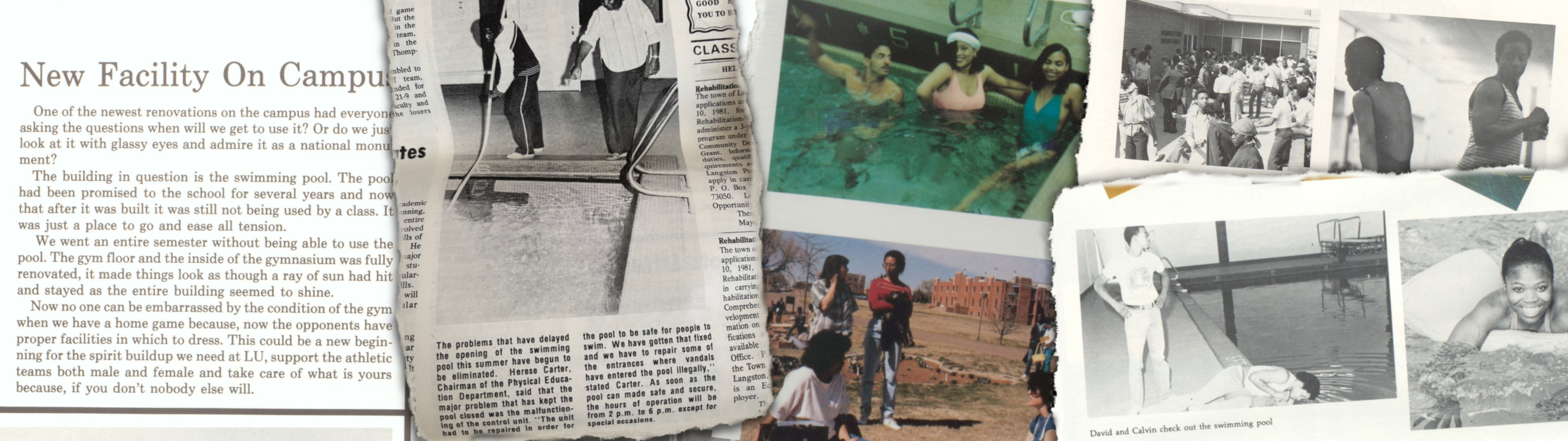
Langston University is home to a rich history, much of which is now lost to time, and many of its buildings carry traces of the past. One such building is the ‘Multi’, which once housed Langston’s own Olympic-sized swimming pool. The pool is still there, but like many of the other dilapidated spaces on campus, it has now been converted into a storage facility.

There is very little information about the pool, but the yearbooks from the 70s and 80s have some sparse mentions of it and pictures of students around the pool. The only people who seem to know what happened to it are those who were around at that time.
Langston’s longest-employed instructor, Coach Hilliard, has been around during the pool’s entire lifespan. He was in his sophomore year when the pool was built in 1977, and he has been employed with the university since 1986. He even had an office in the pool room.
Hillard’s roommate was admitted to Langston with a swim scholarship, but the university has never had an official swim team. Hillard believes this was either due to a lack of participants or because there was never an instructor for the team. The yearbook from 1977 notes that the pool had been promised for many years but was not used for any classes that semester. Instead, it was described as “just a place to go and ease all tension.”
In later years, the pool was used for HPER (Health, Physical Education, and Recreation) major classes and to provide WSI (Water Safety Instructor) certifications. WSI certifications qualify individuals to teach swimming and promote swim safety. Student organizations would also use the pool to host events and raise funds. The pool even had student lifeguards, one of whom was Professor Flannigan.
By the mid-90s, the “pH had gotten low, so they just went in and dumped a lot of chemicals into the tank that feeds it,” Hillard said. Over the summer, the water became too acidic, corroding the metal and eventually creating a hole in one of the main supply pipes.
In addition to the leaking pipe, the foundation of the pool had sank around four inches over the years. Every weekend, multiple feet of water would be lost. For a swimming pool filled with around a million gallons of water, that cost a lot to refill every week.


The pool was never a necessary part of Langston. As for the swim team, it never came to fruition. However, to the community, it was an important place, a third space to relax with friends out of the Oklahoma heat. “The pool was a center of not just campus activity, but community activity,” Hillard said.
Although getting this Olympic behemoth back to working order is not feasible today, it would bring joy to the community to have something like it again. Professor Flannigan dreams of a day when the pool can be back. The pool may not be in the books for our university, but it will always be remembered by those who were lucky enough to experience its part in campus life.


Jeremy Arballo
Jeremy Arballo is a sophomore broadcast journalism major. He likes to write about topics that are interesting, and he wanted to write for the Gazette as a creative outlet. He believes the work matters because it helps spread information that students may not otherwise find. Jeremy is interested in photography and has taken nearly all of the photos featured in his stories. He can be reached via his email, jearbal@langston.edu, or his Instagram @JeremyArballo1.


