
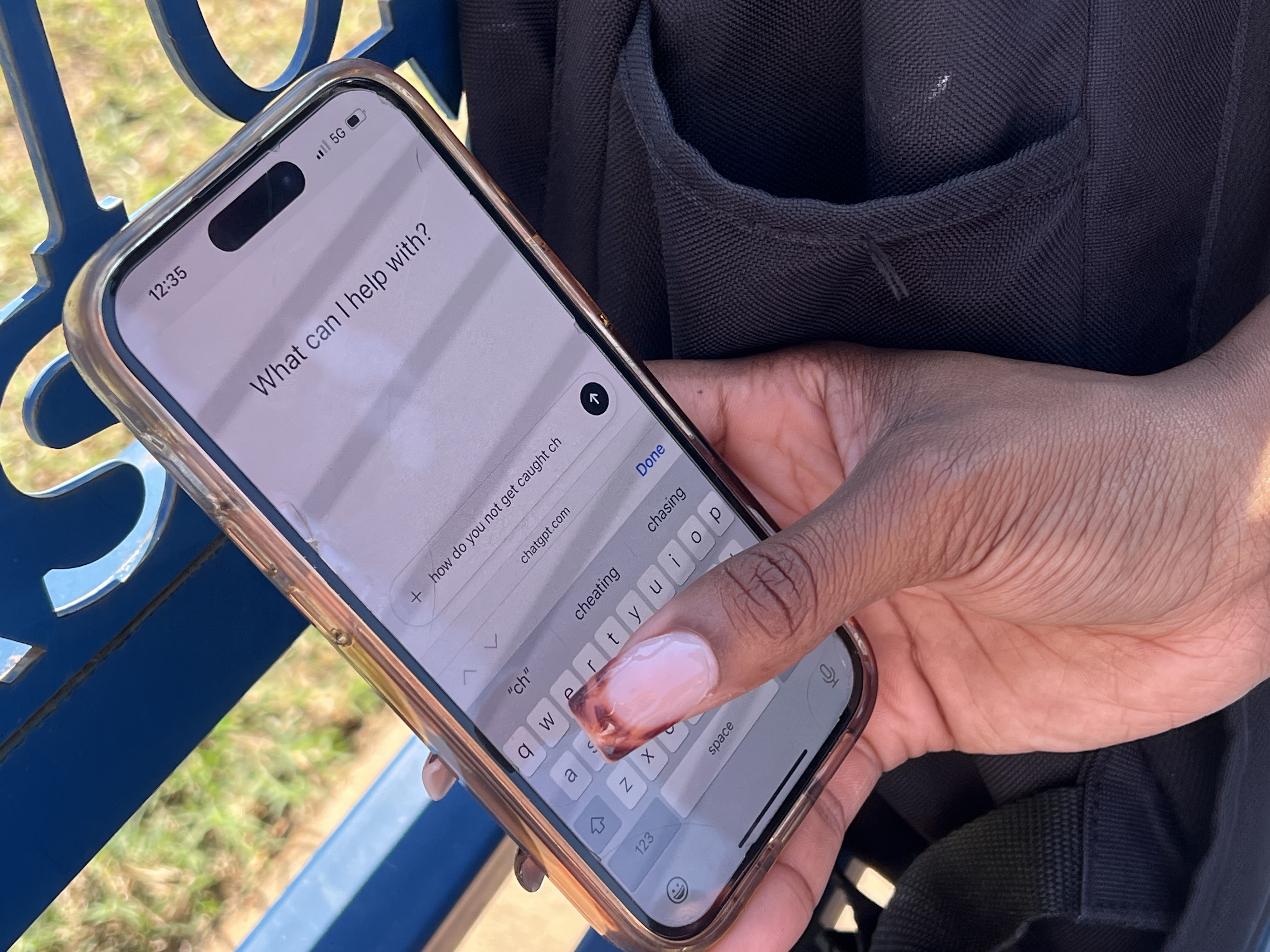
Many students grew up in a generation where technology has continued to evolve, and with that come pros for them, but many cons for their professors. For example, AI has become an essential tool for students to use for their schoolwork and daily life in general. It might be helpful for students, but how do professors feel about the usage of AI in the classroom? How do they make sure students are still learning even when they know they are using AI?
Dr. Layne M. Farmen, Assistant Professor of English at Langston University, has been doing scholarly work with other faculty members on AI. They are working on a piece that is exploring AI on a rhetorical level. Farmen even gave a talk at the Oklahoma State Regents for Higher Education conference and talked about reinventing education with AI. Farmen said, “It’s the kind of technology that has to change whatever one does in the classroom, and it has really impacted writing instructors.”
Farmen explains how there is a lot of fear surrounding the use of AI, and many people ask questions like, “Is this the end of writing?” or “Is this the end of teaching?”
“I don’t think any of this is true,” Farmen said. “It’s just something that we have to adjust with.”
The way that Farmen has adjusted to AI is by teaching his students the limitations of it, what it’s good at, and what it isn’t. Farmen said, “If you haven’t been grading essays for 10 years, if you haven’t been writing essays for 10 years, you’re not going to notice what AI is getting wrong and what it’s leaving out.”

Farmen’s goal for his students is to get them to this level, too. A level where they can tell whether a text is synthetic or human. “Once students are aware of the limitations of the technology, it’ll kind of be up to them to choose to use their own voice rather than lean on this technology too much.”
So how do professors like Farmen make sure that their students are truly learning instead of relying on AI for all the answers? “I go way back to old school and have them handwrite in class,” Farmen said.
Farmen explains how he hasn’t had to do this method for years, but he had to go back to it in all his classes, and although it doesn’t completely eliminate the issue, it mostly does.
Farmen goes on to say that when he does detect that a student is using AI, he says, “I’m not giving you a 0 because you’re cheating, I’m giving you a 0 because it didn’t really do what the assignment required.” Farmen says that just giving a student a 0 doesn’t help the problem, but also explaining what exactly AI did wrong, and his student can learn from the mistake.
Some people believe that AI has affected students’ ability to learn and retain information. Farmen expressed how he thinks that students learn just as well as they always have, and have used resources like AI longer than professors have been aware, and it isn’t their fault.
“I don’t think AI is a permanent damage. What I do think, though, is students have kind of picked it up because it’s pushed everywhere and they try to apply it to places where it doesn’t work very well.” Farmen also adds, “In my perspective, it’s really up to the teachers, if the instructor gives an assignment and every single student uses AI on it, yes, I wish they didn’t do this but, it’s time for the instructor to be like maybe I need to change my instructional method or maybe the students didn’t find this interesting. It’s never just the students’ fault.”
With the normalization of AI, Farmen believes that it is up to the instructors to adjust to this new technology, whether that’s tweaking the rubric or tweaking the assignments being given so that the students won’t feel the need to dump all their work into ChatGPT.

Mikayla Suggs
Mikayla Suggs is a sophomore Broadcast Journalism major. She wanted to write for The Gazette because she enjoys the art of writing and wants to gain experience in writing for a newspaper. Mikayla likes to cover feature stories of all kinds of different people and tell their stories. The work they are doing at The Gazette matters to her because she feels as though there deserves to be coverage of her HBCU and enlighten people on things that don’t commonly get covered. Mikayla’s favorite things to do outside of journalism are reading, listening to music, and just catching up on sleep. If you need to contact her, you can reach her at Mikayla.suggs@okstate.edu.


